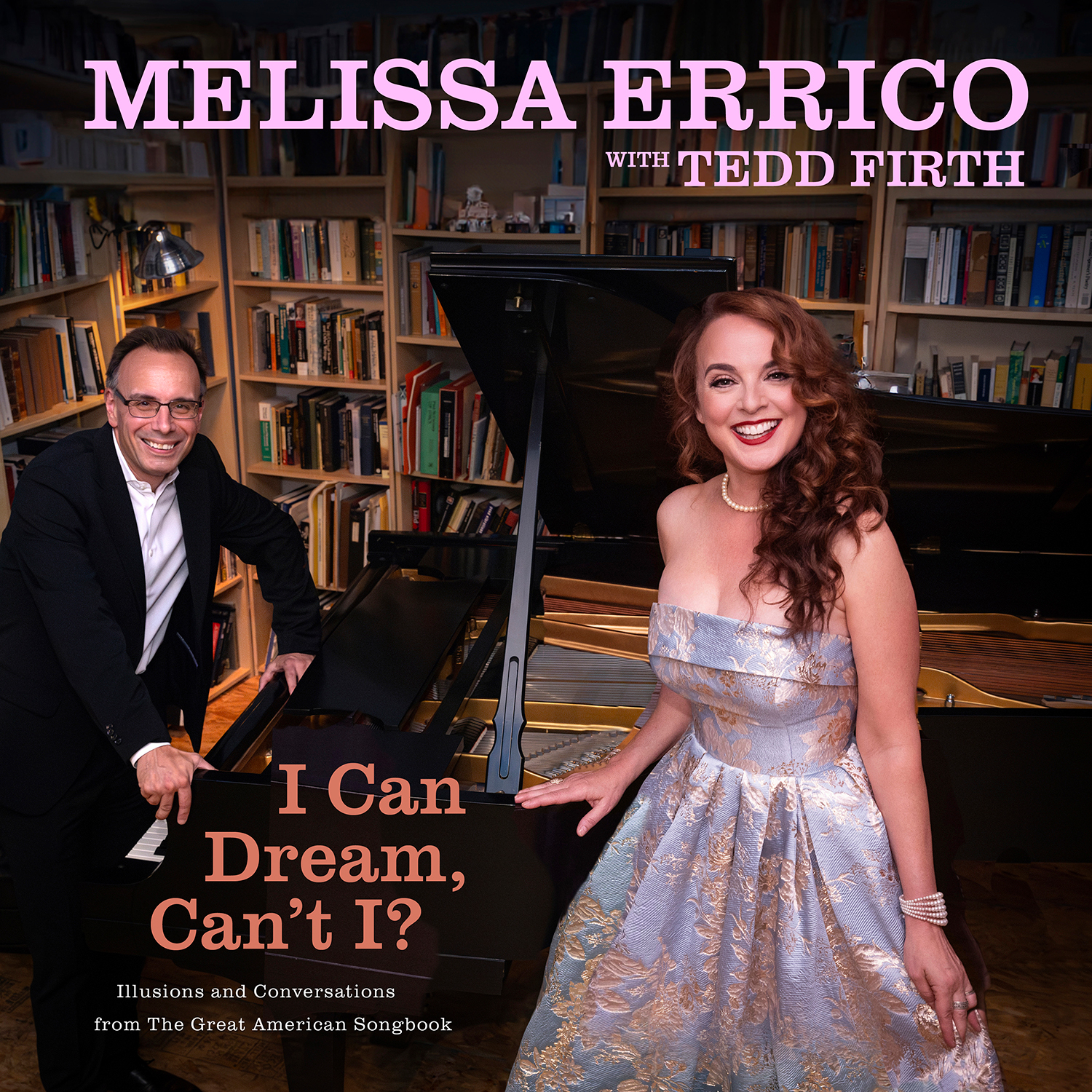
Dreamscape
Liner Notes by Todd Sussman
It started out like a dream…and stayed that way.
Although this album is a collection of standards, here, they are anything but standard. They evade the usual categories of American music: the torch song, the “I want” number, the patter-comedy turn, the wash-that-man-out-of-my-hair song. An intuitively discovered body of work, these are songs of conversation and reflection, songs that ask themselves questions privately…
- I can dream, can’t I?
- When all is said and done, how far can it go?
- Who can say what love is? Does it start in the mind or the heart?
…more than they declare their desires loudly and publicly. There are moons and Junes in these songs, but reality, too. Here are songs of self-reliance and self-reflection, often sad, even when the feelings resolve in equipoise. With Melissa, a song isn’t a torch song. It’s more of a searchlight.
Her selections for this album are drawn from what she calls “the field of poppies from which sprang Stephen Sondheim’s opium.” Certainly, Errico’s years singing Sondheim have brought her a new and unusual delicacy in her approach to the standards. Her diction, her clarinet of a voice, and all the skill learned in the classroom of the self-conscious ironies and comma-bound contradictions of Sondheim are applied to reimagine the emotional resources of the American Songbook.
So pull up a pillow, a partner, or your favorite pet. Embrace your memories—yes, even a few regrets. Fantasies are welcome here, but longing has equal value, too. You may even find comfort there. With Melissa, you can let the dreaming begin.
Feeling Free In The Studio
Melissa recalls her studio sessions with Tedd Firth, the renowned pianist, arranger and music director: “Tedd and I have always wanted to go into a studio, just the two of us. We have a long history, so we didn’t have to talk it over much. Tedd brought me about 54 songs and played them for me. Some he knew I loved, many were new to me. I would listen to him play and follow the lyrics, letting the words wash over me and paying close attention to the melody, the colors. We kept narrowing the list down to the ones that caught me. How did I live without knowing this song? It’s hard to explain but an intuitive collection emerged. Conversational. Kindred souls. (Perhaps this is what magnets must feel like.) I’m proud we preserved many rare verses that are not often performed. They add detail— preludes that invite the listener in—and are delicately special pieces of music history.”
“This process would not have been possible without our sensitive and deeply poetic engineer, Alex Venguer. From the first moment, I wanted to feel completely natural and intimate. Alex was right there. We also had the loving support of Phil Hall (my voice coach and an accomplished arranger and conductor) who offered his keen ear. We cut additional songs, arriving at the 14 final songs that pointed to a path. I felt they collectively told a story. I think Phil had a more voice-oriented approach. He loves freedom, and when I show who I am. He knows how Tedd and I entangle. The whole recording just unfolded organically. It has been loved every step of the way. In a sense, it is as tender as a dream—full of imagery you really notice, with feelings unguarded, as if you vividly sleep. We didn’t force this. It just happened and we let it.”
Her Leading (Piano) Man
On this album, Melissa is accompanied by just one musician—Tedd Firth. For the past 15 years, they have worked together in live performance as well as on several of her previous recordings, including Legrand Affair (Deluxe Edition), Sondheim Sublime, Sondheim in the City—her two Sondheim collections (with a third on the way)—and Out of the Dark: The Film Noir Project. Tedd explains, “We’ve worked together long enough that I know what the rhythm and flow of putting together a project with her feels like, and hopefully how to get the best out of that process. With I Can Dream, Can’t I?, I recommended a number of songs that wound up on the final album. Melissa is always very generous in giving me a lot of creative input into any project we’re working on, but since we were the only two creative forces in the room on this record, I probably had a more outsize influence than usual.”
“Her vocals are always an inspiration. She is an emotional and expressive singer. Sure, there’s subtext, but at its essence, her voice tells you how she feels. I love that there’s a lot to grab onto as an accompanist—the bigs have to be really big, and the smalls have to be really small. I love going along on the arc of what she’s feeling. There’s a real rush with that.”
“I love making vocal/piano duo records. With I Can Dream, Can’t I?, we picked the songs, figured out what we wanted out of them, and recorded them. Her discography was already impressively diverse, but this new album adds something that wasn’t there before and also features our musical relationship as the central focus. I’ve wanted to make a duo record with Melissa for a long time. We finally made the record, and I am very proud of it.”
Song-By-Song Notes
1. When In Rome (I Do As The Romans Do)
Written in 1962 by Cy Coleman and Carolyn Leigh for the musical, Little Me (but not used in the show), “When In Rome” became a favorite of performers from Peggy Lee to Barbra Streisand. All pure winking wit and melody for its own sweet sake, Coleman and Leigh wrote songs that Sondheim (though grumpily doubting the team’s theatricality) admitted he wished he had written.
Melissa says, “I first learned this song from Blossom Dearie, and when I visited Rome this summer, I kept laughing to myself, hearing it in my mind. It’s about always being true to you, darling, in my fashion! I love music that is woven around wit, songs that make you smile.”
2. I Can Dream, Can't I?
Sammy Fain and Irving Kahal’s haunting 1937 ballad, “I Can Dream, Can’t I?,” was originally written for a musical, Right This Way, that ran a scant 15 performances on Broadway. The song has become one of the perpetually rediscovered classics of the American songbook.
Blessed with the harmonic poetry of Tedd’s liquid touch, Melissa gives the song a new erotic life as a ballad of love longed for and, if not lived in reality, at least kept safe and secret in a dream, with “longing itself as a kind of solace,” as she puts it.
3. I Didn't Know About You
This song was composed by Duke Ellington with lyrics written by Bob Russell, based on an instrumental recorded by Ellington in 1942 under the title “Sentimental Lady.” It has since been sung by some great sentimental ladies like Jo Stafford, Lena Horne, and Joya Sherrill, who did the first vocal recording in 1944.
Melissa says, “If ever there was a song about kindred souls, it’s this one. It has an air of complicity.”
4. There'll Be Another Spring
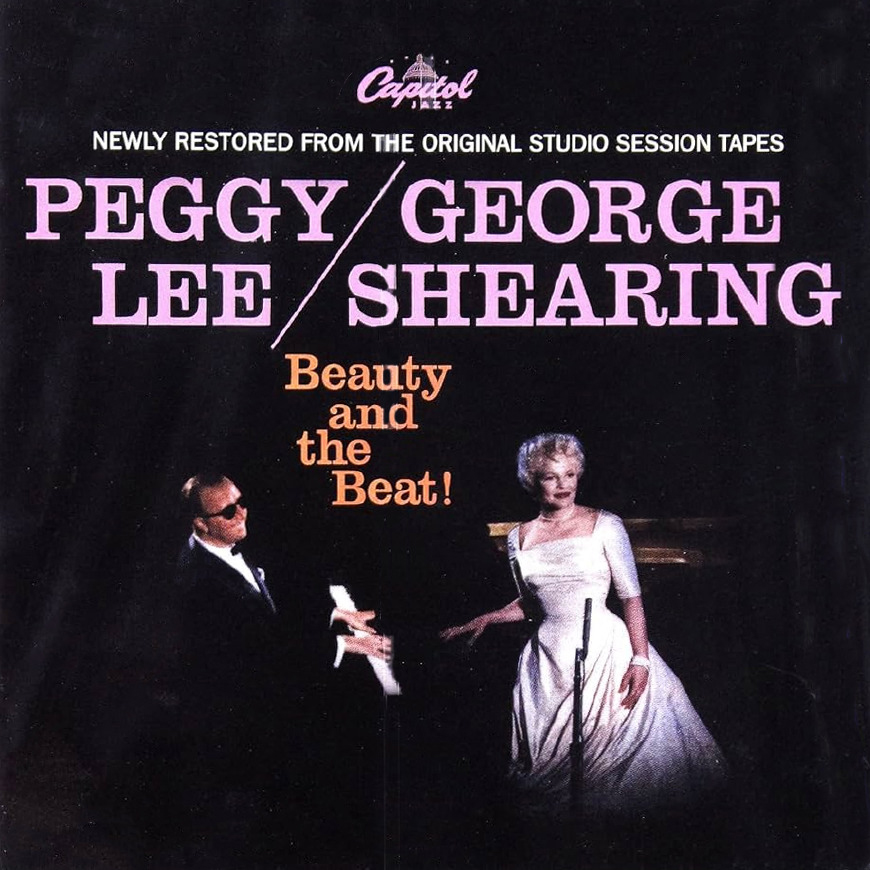
Written by Peggy Lee and Hubie Wheeler, this was first released in 1959 by Lee and George Shearing’s Quintet, on the live recording, Beauty And The Beat!
Melissa shares, “When I chose this song, I was thrilled to discover Lee herself wrote the lyrics, since my concept from the beginning was to pay homage to Beauty and the Beat!, and to someday make an album in intimate conversation with a great pianist. I found Tedd, and here we are! Even our album cover was inspired by Peggy and George’s cover.” Thrillingly, when Melissa first posted the cover on social media, Peggy Lee Associates, LLC saluted her for the heartfelt tribute.
She adds, “As I worked on the song, I was surprised to find that it isn’t a sorrowful song after all, but a song of reassurance to a lover that, even if we can’t be together now, there will be another spring.”
5. Remind Me
“Remind Me” was written by Jerome Kern and Dorothy Fields in 1936 for the unproduced Universal film, Riviera, which was based on the Earl Derr Biggers’ novel, Love Insurance. The novel was later re-adapted for the 1940 film, One Night in the Tropics (1940), and the same Kern and Fields score was used. Although the film was widely regarded as a flop, it marked the movie debut of Abbott and Costello.
“I love that the lyrics are written by one of the great literary women in history—Dorothy Fields,” Melissa says. “The singer here is still in love, and doomed to repeat it all. She’s trying to instruct herself not to lose the battle, which she actually enjoys losing. Her heart is like a wayward friend. It’s her grown-up decision to be, well, a bit ridiculous. She can’t help it.”
6. Dancing On The Ceiling
This sweetly erotic track was written in 1930 by Richard Rodgers and Lorenz Hart for the musical, Ever Green. It entered the Great American Songbook through acclaimed recordings by Frank Sinatra, Ella Fitzgerald, and Jo Stafford. With lines such as “He dances overhead / on the ceiling / near my bed / in my sight / through the night,” Melissa wonders, “Has any lyric ever been sexier than Hart’s incomparable fantasy?
The words, like the music, like the lady here, float.
7. But Beautiful
Johnny Burke’s quiet, wondering lyric for the great Jimmy Van Heusen tune, “But Beautiful” (written in 1947 for Bing Crosby’s film Road to Rio), is among the most conversational and self-effacing songs in the Great American Songbook. It dares to use the prosaic word “discussions” in its verse—“When I hear discussions on what love is”—but never actually defines love at all. Instead, it drifts through a list of possibilities, contradictions, and moods — “funny or sad,” “quiet or mad” — finally deciding only that love is all of these things, and that, somehow, “it’s beautiful.”
“Somehow it feels predictive of… prescient of… a Sondheim song,” Errico says. “There’s a quiet ambiguity in it. Love is not a single feeling, but a shifting weather, something to be discussed and doubted.”
8. Like A Lover
Sergio Mendes and Brasil ’66 released this English language version of “O Cantador,” with music by Dory Caymmi, and English lyrics by Alan & Marilyn Bergman, in 1968. With Alan Bergman recently passing, Melissa says, “When I saw his name on the lyrics (with his wife Marilyn’s), my heart leapt! Then I heard the song, and it melted.”
Melissa knew the Bergmans ever since she starred in Michel Legrand’s musical, Amour, and subsequently made the full-length album, Legrand Affair, with the composer conducting the 100-piece Brussels Philharmonic, produced by Phil Ramone. The Bergmans wrote her an original song for this project, “In Another Life,” and a new verse (at her request) to their classic, “You Must Believe in Spring.” She feels forever dedicated to their legacy. “I hope people enjoy this Brazilian love poem with words by my late, admired, artistic mentors.”
9. Spring Will Be A Little Late This Year
Frank Loesser’s ballad, first heard in the 1944 Deanna Durbin film, Christmas Holiday, remains one of his most quietly affecting works. Melissa describes it as “a song about our inner weather: hopes falter—as we know—and renewal can be delayed. Tenderness survives the chill, and I tried to explore that sense of looking for inner strength.”
With British filmmaker Matthew Edginton, Errico created her own melancholy holiday music video (available on YouTube) to accompany this track, filmed on the streets of New York, aglow with Christmas.
10. Lost In His Arms
This track directly reflects Melissa’s intuition that songs on this collection are drawn from the aforementioned “field of poppies from which sprang Sondheim’s opium.” From Irving Berlin’s 1946 musical, Annie Get Your Gun,” this American Songbook classic appears on Sondheim’s list of “Songs I Wish I Had Written.” Melissa states, “Lyrics like ‘It was dark in his arms, but I had to stay,’ or ‘I lost my way,’ and ‘his arms held me fast and it broke the fall,’ seem Sondheimian in their deceptive simplicity, and very much in keeping with our emotional obstacle course.” She adds, “While you are singing this song, you realize it’s not just romantic.”
11. All In Fun
“All in Fun,” from the musical, Very Warm For May (1939), has lyrics by Sondheim’s mentor, Oscar Hammerstein II, and a melody by Jerome Kern, one of his masters. The song narrates a relationship between two people who change each other’s lives while juggling their private desire. Says Melissa, “I see this song as its own classic romantic comedy by Preston Sturges—all in fun, but not entirely so, with a bittersweet turn.”
12. Listen Here
Dave Frishberg’s “Listen Here” is a late-1970s urban nocturne, written and first recorded around 1978–79, when the composer began turning away from his famous satiric songs towards a more intimate address. The song feels sung into the dark—cool on the surface, but charged underneath, where self-command replaces romance. Melissa describes it as “a reckoning: memory, appetite, and survival quietly negotiate. And, again, I thank Tedd for finding it!”
“I let the album take a sudden ‘modern classic’ turn,” she reflects. “The song suggests a woman becoming stronger, wiser, fuller, even as she looks into the half-lit corners of her inner self. I wanted this album to be romantic, songs of souls entangled. Entanglement interests me. In this song, she’s talking to herself, and untangles.”
13. Both Sides Now
It is no accident that Melissa’s new album resolves with the Joni Mitchell classic, “Both Sides Now,” for Joni is the master of the introspective soliloquy. This time, the song is approached not from the point of view of a puzzled near-teenager, but from the view of a grown adult who knows that clouds, like love, are not illusions but necessary fictions, even if they come and go with the wind. “Joni Mitchell claims not to know life, or love, at all. But, of course, she does. Clouds…dreams and schemes…and ice cream castles in the air. These lyrics are the kinds of illusions I wanted to explore,” says Melissa. “The moons and Junes, yes, but the other side—the illusions we choose, as well.”
14. After You, Who?
“This song from 1932 by Cole Porter had to be on this album. But it didn’t feel like it existed in the central storyline, so I made it a bonus track, a coda. Like the credits rolling,” Melissa says.
“It seemed to be a looking back, real or imagined, at love. How does love ever stop? How do we ever go on? Who would I laugh with?,” she adds. “My favorite line and favorite rhyme: Who else could change my tears into laughter / after you?”
She finishes the album in her heart, and in her mind, with—what else?—another question.
Track List
1. When In Rome (I Do As the Romans Do)
(cut from Little Me, 1962)
Music by: Cy Coleman, Lyrics by: Carolyn Leigh
2. I Can Dream, Can’t I?
(Right This Way, 1937)
Music by: Sammy Fain, Lyrics by: Irving Kahal
3. I Didn’t Know About You
(1944)
Music by: Duke Ellington, Lyrics by: Bob Russell
4. There’ll Be Another Spring
(1959)
Music & Lyrics by: Peggy Lee, Contributions: Hubie Wheeler
5. Remind Me
(One Night in the Tropics, 1940)
Music by: Jerome Kern, Lyrics by: Dorothy Fields
6. Dancing On The Ceiling
(Ever Green, 1930)
Music by: Richard Rodgers, Lyrics by: Lorenz Hart
7. But Brautiful
(Road to Rio, 1947)
Music by: James Van Heusen, Lyrics by: Johnny Burke
8. Like A Lover
(1967)
Music by: Dory Caymmi, Lyrics by: Alan & Marilyn Bergman
9. Spring Will Be A Little Late This Year
(Christmas Holiday, 1944)
Music & Lyrics by: Frank Loesser
10. Lost In His Arms
(Annie Get Your Gun, 1946)
Music & Lyrics by: Irving Berlin
11. All In Fun
(Very Warm For May, 1939)
Music by: Jerome Kern, Lyrics by: Oscar Hammerstein II
12. Listen Here
(1979)
Music & Lyrics by: David Frishberg
13. Both Sides Now
(1966)
Music & Lyrics by: Joni Mitchell
BONUS TRACK:
14. After You, Who?
(Gay Divorce, 1932)
Music & Lyrics by: Cole Porter
With Gratitude
I want to thank our engineer, Alex Venguer—you set us free, you make creating so possible. I love you.
Thank you, Tedd Firth. I am forever full of love for what we both love to do.
I’d like to thank my voice coach, Phil Hall, for listening and believing.
Thank you, Gary Pappani, for being our steadfast project manager, Shorefire Media, Flor Quintas for social media expertise, my loving assistant Gabriella Greco, and filmmaker Matthew Edginton for your joyful creativity. Thank you to my caring mastering engineer, Oscar Zambrano.
Thank you, Mark Shoolery, for years of vibrant graphic design.
Thank you to so many who lift me up and teach me—like Dominic McHugh, Will Friedwald, Charlotte Moore, and my liner notes writer, Todd Sussman, who articulated with such care; my best friend Beth Rogers who knows my soul; and Adam Gopnik for enlightening me and Tedd—and for encouraging my imagination. Thank you to my voice teacher, Joan Lader, Wednesdays at noon.
And thank you, of course, to my family, my husband Patrick McEnroe and my parents, for being the wild joy that enlivens every day and makes me both gypsy and mother. I am so lucky for you and hope you will always hear me in this music, alive and happy in my work.
The Dream Team
Vocals: Melissa Errico
Piano: Tedd Firth
Engineered by: Alex Venguer
Producer: Phil Hall
Mastered by: Oscar Zambrano
Recorded at: Oktaven Audio, NY
Press: Shorefire Media
Project Manager: Gary Pappani
Liner Notes: Todd Sussman
Graphic Design: Mark Shoolery
Cover Photography: Matt Baker